The Bureau of Labor Statistics (BLS) reported a stunning 9.5% jump of productivity in the third quarter. Productivity , simply put, is output per labor hour. With unemployment rate expected to top 10% soon, workers who still have jobs are beeing squeezed to get the job done. How much longer can companies go without hiring by simply squeezing every bit out of productivity?
Although history does not always repeat in the same manner, it may be fun to do a little bit of pre-weekend economics homework by looking into the past. I looked at the economic downturn in the last 40 years. The economic downturn refers to the peak to trough of the US economy as marked by National Bureau of Economic Research (NBER).
The first date marked the peak of a business cycle while the second date marked the trough (the end of the downturn) and the number in parenthesis marked the quarter.
1. December 1969(IV) --November 1970 (IV)
Productivity peaked 1 quarter after the end of downturn. Unemployment peaked 1 month after the end of downturn.
2.November 1973(IV)-- March 1975 (I)
Productivity peaked 1 quarter after the downturn ended. Unemployment peaked 1 month after the end of the downturn
3. January 1980(I)-- July 1980 (III)
Productivity peaked 2 quarters after the downturn ended. Unemployment peaked in the very same month the downturn ended.
4. July 1981(III) --November 1982 (IV)
Productivity peaked 2 quarters after the downturn ended. Unemployment peaked 1 month after the downturn ended
5. July 1990(III)-- March 1991(I)
Productivity peaked 4 quarters after the downturn ended while unemployment 15 months after the downturn ended
6. March 2001(I)-- November 2001 (IV)
Productivity peaked 7 quarter later although there was a significant spike 1 quarter after the downturn ended.Unemployment peaked 17 months after the end of downturn
7. December 2007(IV) -- ???
By a very quick look at these numbers, one may notice a difference between the periods in 1970s,80s and the periods in 1990s,2000s. During downturns in 1970s,1980s, productivity and unemployment peaked soon after the end of the downturn (within a quarter or two for productivity and a month or two for unemployment). In contrast, productivity and unemployment peaked long after the end of downturns was marked in 1990s and 2000s (as long as 5 quarters and/or 17 months).
What contributed to such a long lag between the bottom of the downturn and the peak of productivity and unemployment? A wild guess of mine would be technology and outsourcing. Technology nowadays enables a company to go by just fine without many in-house supporting services such as accounting, human resources, customer services. These tasks can all be outsourced in order to save cost. I suspect this will also be the case for this downturn. Productivity and unemployment rates can stay high long after the trough has been reached.
Ok, now. The next question is: Have we reached the trough yet?
Thursday, November 5, 2009

Retailer October Round-Up
It's that time of the month again when retailers reported their monthly sales. The industry reported October same store sales growth of 1.8%, slightly below analysts' estimates of 2.0% according to Thompson Reuters.
In general, almost all sub-sectors of retailers posted some sales gains from September except for teenage apparel and departmental stores. The following is a snapshot of the % change of same-store sales, an important metric of retailers' performance and the % of total sales [Click on the diagram to enlarge the view].
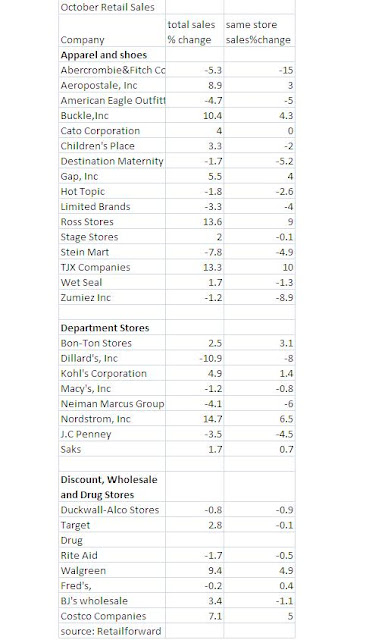
In general, almost all sub-sectors of retailers posted some sales gains from September except for teenage apparel and departmental stores. The following is a snapshot of the % change of same-store sales, an important metric of retailers' performance and the % of total sales [Click on the diagram to enlarge the view].

Wednesday, November 4, 2009
The Fed maintains a sweet spot
From FOMC Statement
On the real economy:
With substantial resource slack likely to continue to dampen cost pressures and with longer-term inflation expectations stable, the Committee expects that inflation will remain subdued for some time.
Monetary policies:
The Committee will maintain the target range for the federal funds rate at 0 to 1/4 percent and continues to anticipate that economic conditions, including low rates of resource utilization, subdued inflation trends, and stable inflation expectations, are likely to warrant exceptionally low levels of the federal funds rate for an extended period.
To provide support to mortgage lending and housing markets and to improve overall conditions in private credit markets, the Federal Reserve will purchase a total of $1.25 trillion of agency mortgage-backed securities and about $175 billion of agency debt. The amount of agency debt purchases, while somewhat less than the previously announced maximum of $200 billion, is consistent with the recent path of purchases and reflects the limited availability of agency debt. In order to promote a smooth transition in markets, the Committee will gradually slow the pace of its purchases of both agency debt and agency mortgage-backed securities and anticipates that these transactions will be executed by the end of the first quarter of 2010.
Off the top of my head
The economy is in the "sweet spot" for the next 3 to 6 months-- economic activities continue to improve while monetary policies continue to be very accomodating. Cheap money is always welcomed. Stock market and bond market should be able to benefit from liquidity and subdued inflation and inflation expectations. New highs can be made. Low interest rates should continue to lead to weak US dollar. In the immediate short term, however, I would be cautious about 3-5% pullbacks of the stock market (e.g.Dow getting to aroung 9650) as substantial resource slack may shake confidence easily after an extended rally.
On the real economy:
- Economic activity has continued to pick up.
- Conditions in financial markets were roughly unchanged.
- Activity in the housing sector has increased over recent months.
- Household spending appears to be expanding but remains constrained by ongoing job losses, sluggish income growth, lower housing wealth, and tight credit.
- Businesses are still cutting back on fixed investment and staffing, though at a slower pace
- Businesses continue to make progress in bringing inventory stocks into better alignment with sales.
With substantial resource slack likely to continue to dampen cost pressures and with longer-term inflation expectations stable, the Committee expects that inflation will remain subdued for some time.
Monetary policies:
The Committee will maintain the target range for the federal funds rate at 0 to 1/4 percent and continues to anticipate that economic conditions, including low rates of resource utilization, subdued inflation trends, and stable inflation expectations, are likely to warrant exceptionally low levels of the federal funds rate for an extended period.
To provide support to mortgage lending and housing markets and to improve overall conditions in private credit markets, the Federal Reserve will purchase a total of $1.25 trillion of agency mortgage-backed securities and about $175 billion of agency debt. The amount of agency debt purchases, while somewhat less than the previously announced maximum of $200 billion, is consistent with the recent path of purchases and reflects the limited availability of agency debt. In order to promote a smooth transition in markets, the Committee will gradually slow the pace of its purchases of both agency debt and agency mortgage-backed securities and anticipates that these transactions will be executed by the end of the first quarter of 2010.
Off the top of my head
The economy is in the "sweet spot" for the next 3 to 6 months-- economic activities continue to improve while monetary policies continue to be very accomodating. Cheap money is always welcomed. Stock market and bond market should be able to benefit from liquidity and subdued inflation and inflation expectations. New highs can be made. Low interest rates should continue to lead to weak US dollar. In the immediate short term, however, I would be cautious about 3-5% pullbacks of the stock market (e.g.Dow getting to aroung 9650) as substantial resource slack may shake confidence easily after an extended rally.
Subscribe to:
Posts (Atom)